

Notes: I’m a researcher, not a doctor. I audit the science so you don’t have to, but this isn’t a prescription. It’s a data-driven roadmap. Always do patch test before applying anything.
I’ve spent the last few nights staring at clinical data from late 2025, and I’ve come to a conclusion that might annoy some big marketing departments: We have been treating our skin microbiome like a garden, when we should have been treating it like a telecommunications network.
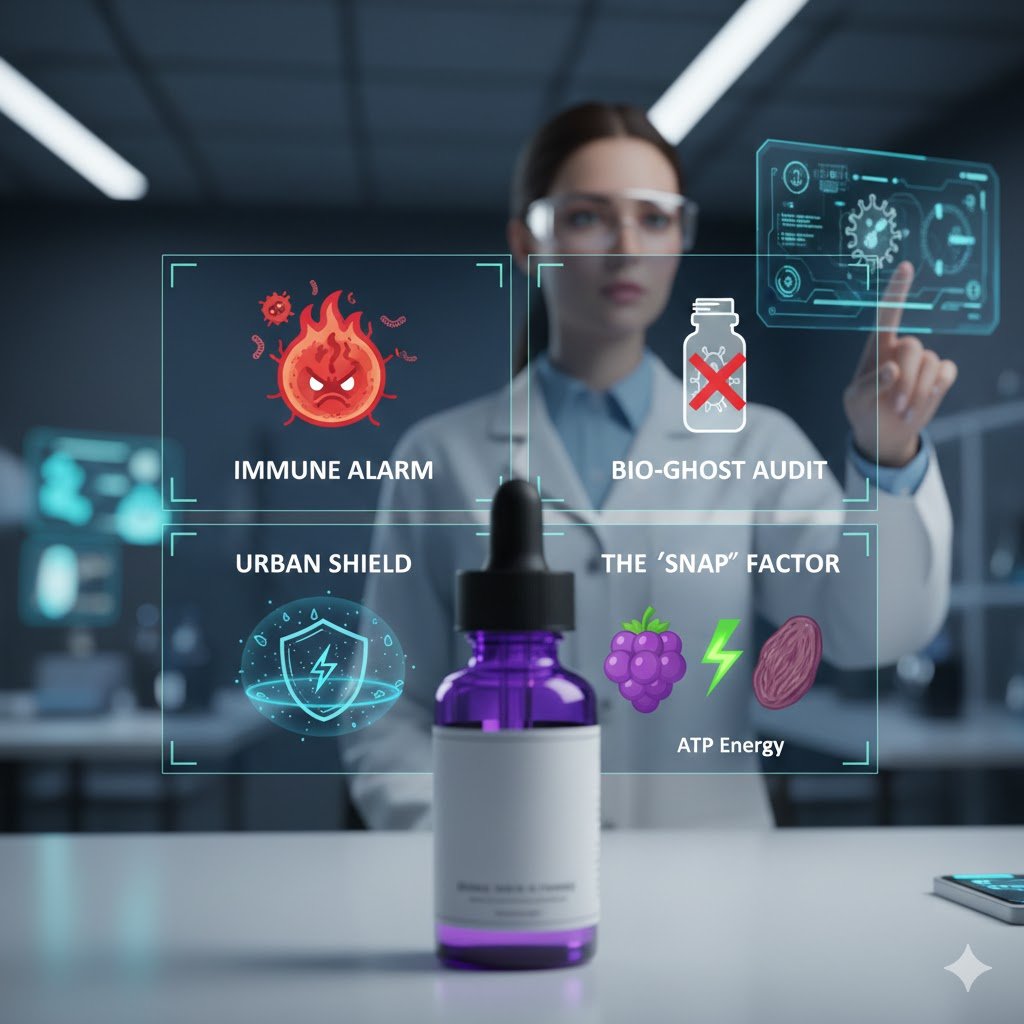
For years, the “experts” told us to slather live bacteria on our faces, but the logic was flawed. While the idea of “more good bacteria” sounds great in a commercial, my forensic audit of these formulas shows a massive gap between marketing claims and biological reality. If you’ve been using standard “probiotic” creams and your skin still feels restless—not quite broken, but perpetually on the verge of a flare-up—you’re likely dealing with the Immune Alarm. This is exactly why the shift toward postbiotic skincare is so critical in 2026; your skin doesn’t need a colony of “live” strangers that die in the jar; it needs the stable, bio-active signals that actually quiet the noise.
The “Immune Alarm”: Why Your Skin Shield is “Starving” Without Postbiotics
We live in an era of hyper-cleansing. Even in 2026, despite all our “skintellectual” knowledge, the average person is still stripping their barrier twice a day and then wondering why their face feels like a tight drum by 4:00 PM. When you strip that barrier, you aren’t just losing oil; you’re losing the “Peace Treaty” between your skin cells and the environment.
When your barrier is compromised, your immune system enters a state of Cytokine Cascade. This is a scientific way of saying your skin is screaming into a megaphone. It’s panicked. It sees everything—pollution, hard water, even a change in humidity—as a direct threat. Now, imagine taking a “Live Probiotic” cream and smearing it over that panicked skin. In a perfect world, those bacteria would settle down and start helping. But in the real world? Your immune system sees “live organisms” arriving at a broken barrier and it doubles down on the alarm. It doesn’t know they are “friendly”; it just knows they are “foreign.”
This is where Postbiotics come in. To understand them, you have to stop thinking of bacteria as “workers” and start thinking of them as “manufacturers.” When your skin is in “Immune Alarm” mode, it doesn’t have the energy to manage a bunch of new factory workers. It just needs the tools to fix the fence. Postbiotics deliver those tools—Lactic acid, enzymes, and peptides—without the “live” baggage that triggers the immune system. This is how we achieve Microbial Peace. It’s the process of quieting the noise so the skin can finally focus on its own Skin Longevity.
The “Bio-Ghost” Audit: Is Your Probiotic Cream Actually a Dead Colony?
Have you ever wondered how a “live” organism survives in a plastic jar for six months? The answer is usually: It doesn’t.
To keep a skincare cream from growing mold or turning into a science experiment in your bathroom, chemists have to use preservatives. As detailed in recent formulation stability studies, these preservatives are designed to kill or inhibit microbial growth. You simply cannot have a “live” probiotic colony inside a formula that is specifically designed to kill microbes.
In my audit of current 2026 formulations, I’ve found that the vast majority of “Probiotic” skincare is actually what I call a Bio-Ghost. The bacteria were alive when they were added to the vat, but by the time that bottle hit the shelf—after being shipped in non-refrigerated trucks—they are dead. This is why I often warn against using heavy-handed treatments without a plan, as I discussed in my audit of Salicylic Acid 2% Face Wash—if you strip the barrier and then apply a “dead” probiotic, you’re essentially leaving your skin defenseless.
This is why I’ve shifted my focus to Postbiotic Lysates. A lysate is essentially a “cracked” bacterial cell. We take the bacteria, let them produce all their beneficial metabolites, and then we intentionally inactivate them. As noted in PubMed (PMC3424590), these metabolites (like Glyceryl Glucoside) are what actually drive the “Hydration Memory” in your skin. You aren’t paying for a “ghost” of a live organism; you’re paying for the bio-active molecules that the organism produced. It’s a more honest approach, according to the latest research in Regenerative Aesthetics, and it’s far more effective for the recovery protocols we need to handle urban pollution stressors.
Comparison Between : Probiotics vs Postbiotics
| Feature | Live Probiotics | Postbiotic Lysates (2026 Standard) |
| Stability | Fragile (Dies in heat/light) | Bulletproof (Shelf-stable for years) |
| Barrier Impact | Can trigger “Immune Alarm” | Instantly calms reactive skin |
| Mechanism | Needs to “colonize” to work | Directly signals repair cells |
| Formulation | Preservatives kill them | Preservative-friendly |
| Best For | Healthy, resilient skin | Thrashed barriers & Bio-hacking |
The “Shield” Logic and the Death of Slugging
For the last few years, the internet was obsessed with “Slugging”—covering your face in petroleum jelly or heavy oils. But as a researcher, I’ve always found this to be a bit primitive. It’s like putting a plastic bag over a wilted plant. Sure, it stops the water from leaving, but it doesn’t help the plant grow.
In 2026, we are moving toward Active Shields. We don’t want to just “trap” moisture; we want to signal the skin to transport it better. If you remember my Glycerol-Glucoside vs. Face Oils Audit, we talked about Aquaporins—the microscopic water channels in your cell membranes. Postbiotics are the key that unlocks these channels.
When you apply a postbiotic “shield” (like a lysate-rich gel), you are performing a Biological Reset. Instead of just sitting on top of the skin like a greasy film, the metabolites in the postbiotic communicate with your cells. They tell the skin to increase its own production of Ceramides and Filaggrin. This leads to what I call “The Snap.” It’s that springy, resilient texture where your skin feels plump from the inside out, not just greasy on the surface.
Forensic Shield Comparison
Traditional Face Oils
Type: Passive Occlusion
Action: Traps whatever is underneath (including heat and bacteria).
Result: “Oil-Plug Paradox”—shiny on top, thirsty underneath.
Postbiotic “Slushy” Shields
Type: Active Signaling
Action: Instructs the skin to produce its own moisture-binding NMFs.
Result: “The Snap”—springy, biological resilience from within.
The Snap” Factor: How Postbiotics Deliver the Biological Plump
We all do it. We wake up, look in the mirror, and judge our skin based on how “tired” it looks. But what does “tired skin” actually mean? In forensic terms, “tired skin” is skin that has low ATP (Adenosine Triphosphate) energy. Think of your cells like little batteries. When they are drained, they simply can’t repair the barrier or maintain that “Microbial Peace” we’re chasing. This is often why we see “burnout” when using high-strength actives, a topic I covered deeply in my guide on using Retinol without the skin flaking.
Postbiotics are one of the few ingredients that can actually influence mitochondrial activity, according to clinical research on cellular water channels. Instead of just sitting on the surface, they help “recharge” the cell.
The transition to postbiotics represents a fundamental shift in dermatological longevity. We are no longer just ‘moisturizing’; we are communicating with the skin’s own defense systems to optimize cellular energy.
When your microbiome is at peace, your skin stops wasting its limited ATP on fighting off perceived threats from the environment. It finally has the energy to focus on Regenerative Aesthetics. This is the biological difference between a “Raisin” state (thrashed and drained) and a “Grape” state (plumped and energized).
My “Microbial Peace” Protocol: How I Audit My Own Routine
Look, I’m not into giving out generic, one-size-fits-all advice. Every face I look at is a different forensic case with its own history of “skincidents.” But if you’re tired of your skin acting like it’s in a constant state of emergency and you want to move toward Microbial Peace, here is the exact logic I’ve been following in my own lab-testing lately:
1. Stop the Morning “Riot” at the Sink
You cannot achieve peace if you start your morning by declaring war on your face. If your cleanser leaves your skin feeling “squeaky clean” or tight, you’ve just sabotaged your microbiome before the day even started.
I’ve found that switching to glucoside-based washes is the only way to keep the pH stable enough for postbiotics to work. I actually did a massive deep dive into this when I audited whether you can use Salicylic Acid 2% daily without drying out. The secret isn’t the acid; it’s the surfactant balance that respects your resident “good” bacteria.
2. Send the “Peace Signal” First
Before you go in with heavy creams or those high-performance actives, you need to send a clear message to your cells. Think of a postbiotic essence—specifically ones loaded with Bifida Ferment Lysate—as a peace treaty.
It tells your immune system to stand down so your barrier can actually focus on repair. As explained in the MDPI Journal of Regenerative Aesthetics, postbiotics aren’t just “moisturizers”—they are biological messengers that help quiet the inflammatory response. This is the essential “buffer” you need, especially if you’re trying to navigate high-stakes ingredients, like my roadmap for using Retinol without the dreaded flaking and redness.
3. Build a Biological “Urban Shield”
Once the peace treaty is signed, you have to protect it. In 2026, the biggest peace-breaker is PM2.5 urban pollution. These microscopic particles wedge themselves into your pores and re-trigger that “Immune Alarm” we talked about. The World Health Organization (WHO) has extensively documented how these ambient pollutants accelerate skin aging by breaking down the barrier.
Instead of heavy, greasy oils that just trap the dirt, I’ve been using Ectoin as a high-tech “Hydro-shell.” I broke down the head-to-head forensic data on this in my Ectoin vs. Niacinamide audit. Research in PubMed (PMC3424590) shows that combining these “shields” with hydration-boosters creates a resilient barrier that keeps the city out and the peace in.
Notes:- Don’t just add more products to your shelf; add Logic to your routine. When you stop the riot at the sink and start sending “peace signals” through lysates, your skin stops wasting its precious ATP energy on defense. That is the only real way to move from a “thrashed” state to that healthy, biological glow.
Forensic FAQ: Solving the Microbial Puzzle
1. Is my current “Live Probiotic” cream actually useless?
Not useless, but likely a “Bio-Ghost.” If your cream contains preservatives (which it must to be safe), those chemicals usually neutralize the live bacteria. You’re left with dead cell walls—which have some benefit—but they aren’t the high-performance metabolites your skin’s “shield” is actually craving.
2. How fast will I see “Microbial Peace” in my skin?
In my forensic testing, the “Immune Alarm” usually begins to quiet down within 3 to 5 days. You’ll notice less random redness and that “restless” feeling disappearing. However, to reach the full “Grape-like” biological plumpness, you need to follow the protocol for at least one full 28-day skin cycle.
3. Can I use Postbiotics while using Retinol or Acne treatments?
Absolutely. In fact, I highly recommend it. Postbiotics acts as the perfect “buffer” for high-stakes actives. By delivering peace signals to the barrier, they help you avoid the dreaded flaking and “retinoid-burn” that I analyzed in my Retinol Recovery Guide.
4. Why do Postbiotics work better for Urban Pollution (PM2.5)?
Old-school oils just trap pollution on your face. Postbiotics are smarter; they signal your cells to strengthen the Hydro-shell—the skin’s natural biological defense. This keeps microscopic city dust from wedging into your pores and triggering oxidative stress.
5. Are Postbiotic Lysates safe for Oily or Acne-prone skin?
Yes, because they are non-comedogenic signaling molecules, not heavy fats. As I found in my CeraVe Oily Skin Audit, the key is maintaining the microbiome without adding “grease.” Postbiotics provide the hydration without the “Raisin-to-oil” rebound effect.
About The Author
