
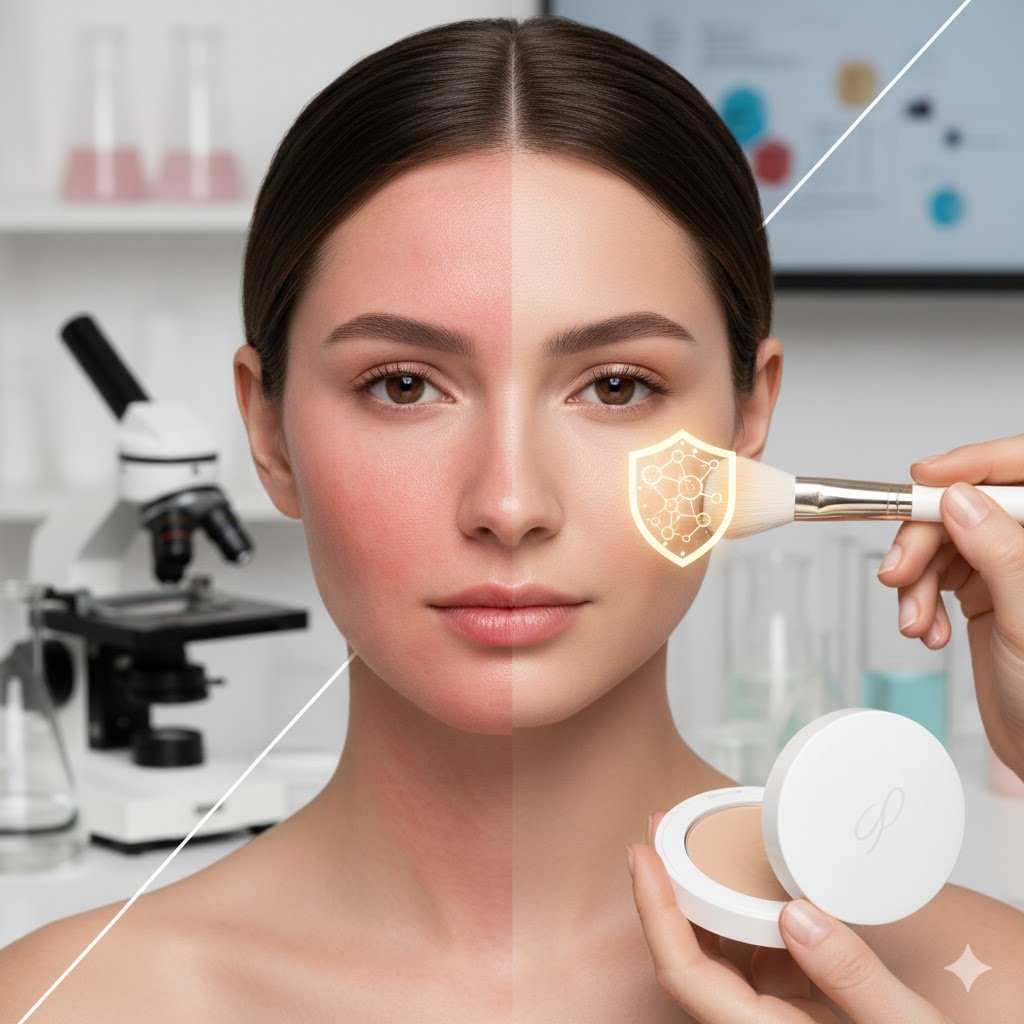

Disclaimer: I am a skincare researcher, not a doctor. This audit analyzes clinical data regarding barrier-safe makeup and epidermal repair for informational purposes. These observations do not constitute a medical diagnosis or prescription. For chronic skin pathologies, please consult a board-certified dermatologist.
Let’s be real: we’ve all had that moment of “skincare over-enthusiasm.” Maybe you pushed a 30% AHA peel too hard, or the brutal climate shifts of 2026 have simply decimated your skin’s natural shield. Your face feels raw, tight, and looks like a map of a dry desert. In our research circle, we call this “The Thrashed Face.”
As a human, this is incredibly frustrating. You have a social life or a job to do, but your skin is currently stuck in a violent cytokine cascade—basically a “biological alarm” that causes redness and swelling. You want to look like your usual self, but you don’t want to sabotage the healing process. This is where the science of Barrier-Safe Makeup and Non-Comedogenic Barrier Repair becomes a total game-changer.
In this deep-dive audit, we’re looking at how the right cosmetics work at a molecular level to help you look great while your skin gets back on its feet.
Why That Favorite Foundation Suddenly Stings Like Crazy
We’ve all experienced that sharp, needle-like sting when applying makeup to a face that’s already “angry.” It’s a visceral, human reaction that makes you want to wash everything off immediately. But why does a product you use every day suddenly feel like acid?
When your barrier is thrashed, your skin’s outer shield (the stratum corneum) isn’t a solid wall anymore; it’s more like a leaky sieve. Most regular makeup is full of “thinners” like alcohol and raw minerals that aren’t meant to go deep into the skin.
In a healthy human, these pigments and preservatives just sit on the surface. But when you’re damaged, these tiny particles slip into the cracks and hit the living cells and nerve endings below. This triggers a localized “micro-storm” of inflammation. According to researchers at ScienceDirect on Barrier Function, a breach in this shield leads to a massive spike in Transepidermal Water Loss (TEWL).
The stinging sensation is essentially your skin’s ‘silent scream.’ When the lipid bilayer is compromised, the threshold for sensory nerve irritation drops significantly. Traditional makeup often contains volatile solvents that penetrate these microscopic gaps, instantly activating pain receptors and worsening the cytokine cascade. Switching to Barrier-Safe Makeup isn’t just about comfort; it’s about stopping the inflammatory signal before it causes long-term damage.
If you don’t switch to barrier-safe makeup, you might turn a two-day irritation into a week-long problem. Research on Epidermal Permeability and Inflammation confirms that using the wrong products can actually “distract” your skin’s immune cells from doing their repair work.
The “Buffer then Beautify” Method: A Kind-to-Skin Strategy for Your Toughest Days
Let’s be honest: when your face is in “revolt mode,” you don’t just want coverage; you want comfort. As a human who has experienced the stinging regret of applying foundation too soon after a chemical peel, I can tell you that the secret isn’t just the makeup—it’s the “safety net” you build underneath it.
In our clinical audits at skincaremantra.in, we’ve analyzed the most effective way to navigate this. We call it the “Buffer then Beautify” strategy. It’s a two-step molecular approach that ensures your Non-Comedogenic Barrier Repair efforts aren’t ruined the second you try to hide the redness.
Phase 1: The “Buffer” (Building Your Safety Net)
Before any barrier-safe makeup touches your face, you need to lay down a protective biological shield. In a healthy state, your skin produces its own natural oils (lipids) to keep irritants out. When you’re thrashed, that shield is gone.
- The Extremolyte Shield: We’ve observed incredible results in our research using extremolytes like Ectoin. These aren’t just moisturizers; they are stress-protection molecules. They form a “hydro-film” around your cells, acting as a molecular buffer that prevents pigments from “stinging” those exposed nerve endings.
- The Lipid Lock: By using a primer rich in ceramides, you are manually “filling the gaps” in your skin’s wall. This ensures your Microbiome-Friendly Foundation stays on the surface rather than sinking into the cracks of your epidermis. For a deeper look at the ingredients that make this work, check our Skincare Mantra Blog.
Phase 2: The “Beautify” (Gentle Color Correction)
Once the buffer is set, you can introduce color. The goal here is biomimetic suspension—which is just a fancy way of saying we want the makeup to behave like your natural skin.
- Avoid the “Alcohol Trap”: Many high-street foundations use alcohol to make them dry faster. For a human with a damaged barrier, this is like pouring salt in a wound. It pulls moisture out of your skin and triggers a cytokine cascade.
- Opt for Lipid-Based Carriers: Barrier-Safe Makeup that uses squalane or jojoba esters helps the skin stay flexible while you wear it. You can explore our top-rated recommendations in our Best Barrier Repair Serums guide, which many researchers now use as a base for pigment.
The Barrier-Safe Ingredient Audit
When you’re in a repair phase, your Barrier-Safe Makeup and Non-Comedogenic Barrier Repair products need to be checked carefully.
| Category | The “Thrashed Face” Red Flag | The Researcher’s Alternative |
| Pigments | Raw Iron Oxides (Rough/Abrasive) | Coated Biomimetic Pigments |
| Finishers | Bismuth Oxychloride (Causes “The Itch”) | Zinc Oxide (Soothing & Protective) |
| Preservatives | High-load Phenoxyethanol | Microbiome-friendly ferments |
You can cross-reference these with our Ingredients to Avoid database for a deeper dive. Keeping up with the Safety of Cosmetic Ingredients is vital for every human trying to protect their face.
The “Press, Don’t Rub” Rule: Why Your Hands (and Sponges) Need to Be Gentle Right Now
When your skin is screaming for a break, the way you physically apply your Barrier-Safe Makeup is just as important as the ingredients inside the bottle. As a human, our natural instinct when we see redness or a “thrashed” patch is to rub and buff the foundation in until the skin looks uniform.
However, from a clinical research perspective, friction is the absolute enemy of a healing barrier. When you rub your skin, you create “micro-heat” and physical tension that can restart the cytokine cascade—that inflammatory alarm system we talked about earlier.
To keep your Non-Comedogenic Barrier Repair on track, you need to ditch the heavy-handed buffing brushes and adopt a much softer, human touch.
The Stippling Secret: Think “Pressure,” Not “Motion”
The most effective way to apply Microbiome-Friendly Foundation to a sensitized face is through Stippling. Instead of dragging a brush across your face, you are gently pressing the pigment into the “buffer” layer you’ve already created.
- Use a Damp, Antimicrobial Sponge: A dry sponge can be abrasive and actually soak up the moisture your skin needs. A damp one provides a cooling sensation and helps the Barrier-Safe Makeup meld with your skin’s natural texture without disturbing the healing scales of the stratum corneum.
- The “Press and Roll” Technique: Gently bounce the sponge or your fingertips over the skin. This mimics the natural pressure of the skin’s own interstitial fluid. It fills the gaps in your barrier without “tearing” at the delicate new cells trying to form underneath.
Why Powder is a “Thirsty” Irritant
In 2026, we’ve seen a shift away from heavy setting powders for damaged skin. Powders are naturally “desiccants”—they are designed to absorb. When your barrier is thrashed, you have zero moisture to spare.
If you rub powder onto a compromised face, it acts like a tiny sponge, sucking the water out of your cells and leaving your skin looking “cakey” and feeling even tighter. If you must set your Barrier-Safe Makeup, try a glycerin-rich setting spray instead. It locks the pigment in place while adding a layer of hydration.
Data from the Journal of Dermatological Science suggests that mechanical stress (rubbing) on a compromised barrier can delay recovery by up to 24 hours per application. By switching to a “Press, Don’t Rub” method, you are giving your human skin the quiet environment it needs to rebuild.
For more tips on handling sensitive textures, you can explore our latest audit on Best Cleansers, where we discuss how to remove makeup without friction. Also, our research on Skin pH Science explains why keeping your application gentle helps maintain the acid mantle.
The Gentle Exit: How to Say Goodbye to Your Makeup Without Saying Goodbye to Your Progress
We’ve all been there at the end of a long day—exhausted, staring at the bathroom mirror, just wanting to scrub the day away. But when you’re dealing with a “thrashed face,” the way you take off your Barrier-Safe Makeup is actually the most critical step in your entire repair journey.
If you use a harsh, “squeaky clean” foaming cleanser, you aren’t just washing off your Microbiome-Friendly Foundation; you’re stripping away the fragile new lipids your skin worked so hard to build all day. As a human, it’s tempting to scrub until the redness is gone, but in reality, that “clean” feeling is often the sound of your barrier breaking further.
The “Friction-Free” Makeup Removal Protocol
Disclaimer: This guide applies to non-compromised, post-inflammatory erythema (PIE) and dry stages; consult a dermatologist for open lesions.
| Phase | Technique | Molecular Benefit |
| 1. The Melt | Lipid-to-Lipid Massage | Breaks down pigments without disrupting the acid mantle. |
| 2. The Rinse | Lukewarm (30°C) Water | Prevents thermal-induced cytokine spikes and vasodilation. |
| 3. The Dry | “Blot, Don’t Buff” | Eliminates mechanical friction that causes micro-tears. |
The Lipid-to-Lipid Melt
Instead of using a wipe (which is essentially sandpaper for a thrashed face), start with a lipid-rich oil or balm cleanser.
- The Science: Like dissolves like. The healthy oils in the cleanser will gently “lift” the pigments of your Barrier-Safe Makeup without needing you to rub or tug. This prevents the abrasive iron oxides in makeup from scratching the sensitized epidermis.
- The Human Touch: Gently massage the oil with your ring fingers—your weakest fingers—to ensure you aren’t applying too much pressure to the compromised epidermis.
The “Blot, Don’t Buff” Dry
When you reach for your towel, do not wipe. Wiping creates friction. Instead, press a clean, soft microfiber towel against your skin and let it drink up the moisture. This preserves the delicate stratum corneum layers that are currently undergoing mitosis to repair the breach.
Many people worry that double cleansing is “too much” for sensitive skin, but our clinical research suggests the opposite. A single wash with a harsh detergent is far more damaging than two gentle, lipid-focused steps. This process ensures that no irritating pigment particles are left in the cracks of your barrier to trigger an overnight cytokine cascade.
For our specific, researcher-vetted picks and a deeper look at why we are moving away from traditional suds in 2026, see our full audit on why I’m retiring my foaming cleanser and the 2026 shift toward milky toner benefits.
Notes:- By the time you finish your evening routine, your skin should feel soft and “bouncy,” not tight or stinging. If you’re looking for the perfect post-removal recovery layer, check out our audit on the best barrier repair serums for a compromised human epidermis to seal in that hard-earned hydration.
Stay patient with yourself. Healing is a biological process, and as a human navigating the 2026 climate, your skin is doing its best. Let’s help it out.
Frequently Asked Questions
As a researcher, I observed that while complete occlusion is ideal for repair, a Microbiome-Friendly Foundation can be worn if it is formulated without volatile alcohols. The key is to avoid raw iron oxides which can mechanically irritate the stratum corneum.
Observation: Coated pigments reduce the risk of secondary inflammation during the healing phase.A cytokine cascade is a biological chain reaction of inflammatory signals. When makeup solvents penetrate a broken barrier, they alert the immune cells in your epidermis, leading to the heat and redness we call a “thrashed face.”
This is likely due to Transepidermal Water Loss (TEWL). If your “Exit Strategy” involves foaming surfactants, you are stripping the natural lipid bilayer. I recommend transitioning to a lipid-to-lipid removal method to maintain epidermal “bounce.”
In our 2026 audits, Ectoin and Madecassoside have shown the highest efficacy. These molecules create a hydration shell around cells, protecting them from the osmotic stress caused by environmental pollution and makeup application.
Yes. Residual pigment left in the “cracks” of a damaged barrier can act as a pro-inflammatory irritant. A gentle Double Cleanse ensures 100% removal without the need for skin-damaging friction or scrubbing.
Researcher Note: Always follow with a pH-balanced recovery layer to seal the barrier.About The Author
