Forensic Disclaimer: This audit is for informational purposes and based on 2026 dermatological trends. It is not medical advice. Always patch test new molecules, especially when dealing with a compromised barrier.
For years, the gold standard for a “thrashed” barrier was occlusion. We were told to “slug” our skin with heavy oils and petroleum to trap moisture. But as a researcher auditing the shift toward Regenerative Aesthetics, I’ve noticed a significant problem: Occlusion is not the same as biological hydration.
In fact, many of you in the USA, UK, and Canada are reporting that heavy face oils are causing “congestion-driven inflammation.” This is why I am officially retiring my face oils in favor of Glycerol-Glucoside Slushy Gels.
The ‘Oil Plug’ Fallacy: Why Your Barrier is Still Dry
When your skin is in “Biological Burnout,” your natural water channels—known as Aquaporins—are essentially offline.
Applying a heavy face oil on top of dehydrated skin is like putting plastic wrap over a dry sponge. It might stop more water from leaving (TEWL), but it does nothing to help the sponge actually absorb or circulate moisture. This often leads to a “surface-slick but deep-dry” feeling that characterizes chronic barrier frustration.
The Glycerol-Glucoside Forensic: A ‘System Reboot’ for Your Water Pipes
If you’ve ever felt like your skin is a “leaky bucket”—where no matter how much cream you pour in, it just vanishes or sits uselessly on top—you aren’t dealing with a moisture problem. You’re dealing with a plumbing problem.
Inside your skin, you have millions of microscopic “water gates” called Aquaporins. Think of these as the internal irrigation system for your cells. When your barrier is thrashed, these gates don’t just leak; they rust shut.
The “Smart” Molecule: Glycerol-Glucoside
This is where the forensic shift happens. While standard Glycerin is a “dumb” humectant (it just holds water and hopes for the best), Glycerol-Glucoside is an “intelligent” activator derived from desert “Resurrection Plants.”
- The ‘System Restart’: When you apply this molecule, it doesn’t just sit there. It signals the skin to produce more Aquaporin-3 proteins. It’s essentially “greasing the hinges” of your water gates and forcing them to swing open.
- The Internal Flow: Suddenly, the water that was trapped in your lower dermis (or sitting uselessly under an oil plug) starts to circulate. Your skin begins to hydrate itself from the inside out, rather than waiting for a heavy cream to do the work.
The Human Result: ‘The Grape Factor’
When your internal “pipes” finally click back into place, the change isn’t just visible—it’s mechanical. You know that feeling of “Skin Turgor”? In clinical terms, it’s the time it takes for your skin to snap back after a pinch. But in real life, it’s the difference between a raisin and a fresh grape.
- The Sensation: It’s that subtle, springy resistance you feel when you press your cheek. It doesn’t feel like you’ve just “painted” on a layer of grease; it feels like your face is actually fuller from within.
- The Movement: You’ll notice it most when you smile or talk. Instead of the skin “folding” into those tiny, parched crinkles (dehydration lines), it moves like a single, flexible sheet. It has ‘The Snap’—that healthy turgor that makes the light reflect off your cheekbones rather than getting lost in the “sandpaper” texture of a thrashed barrier.
The Forensic Comparison: Raisin vs. Grape
You apply face oils over a thrashed barrier. The surface is shiny, but the cells are shriveled and “thirsty” underneath. Result: Surface slick, deep-dry.
Glycerol-Glucoside opens the Aquaporin gates. Water fills the cells from within, creating a smooth, tight surface. Result: Biological Plumping.
Why ‘Slushies’ Beat Oils in 2026
Based on my recent Ectoin vs Niacinamide Audit, the goal of modern skincare is Atmospheric Resilience. Here is how the Glycerol-Glucoside shift achieves that:
- Mitochondrial Battery Support: As discussed in our 2026 Cellular Audit, cells require intracellular water to produce ATP (energy). Oils don’t fuel the battery; Aquaporin-driven hydration does.
- Temperature Regulation: Slushy textures provide an immediate “thermal drop,” which mutes the cytokine cascade responsible for redness—something heavy oils often exacerbate by trapping heat.
- The Ectoin Synergy: When you layer a Glycerol-Glucoside gel over an Ectoin serum, you create a dual-action system: Ectoin shields the outside, while Glycerol-Glucoside hydrates the inside.
The Mitochondrial Battery: Why Hydration is Actually Energy
In Skin Longevity hydration is actually energy. Your skin cells contain mitochondria—the “batteries” that fuel everything from collagen synthesis to wound healing. For these batteries to produce ATP (Adenosine Triphosphate), they require a specific aqueous environment.
Glycerol-Glucoside has been shown to boost ATP production in aged skin cells by up to 170%. By opening those Aquaporin channels, you are literally giving your cells the “fuel” they need to wake up and start repairing the barrier from the inside.
The Forensic Head-to-Head: Occlusive Oils vs. The ‘Slushy’ Protocol
| The Clinical Metric | Traditional Face Oils | The Glycerol-Glucoside ‘Slushy’ |
| The Biological Logic | Passive Occlusion. A seal to trap existing moisture. | Active Irrigation. Reboots Aquaporin “gates” to circulate water. |
| The 2:00 PM Test | The Mask Effect. Shiny surface, but “papery” feel underneath. | The Biological Snap. Cool, flexible, and plump through the workday. |
| Cellular Metabolism | Metabolically Neutral. Does not influence cellular energy. | Mitochondrial Support. Directly boosts ATP production. |
| Urban Defense | The Particle Magnet. Sticky oils attract city dust (PM2.5). | The Molecular Repellent. Weightless film repels pollutants. |
| The Visual Result | The ‘Grease’ Finish. Often leads to congestion and redness. | The ‘Grape’ Plump. Bouncy and calm from the inside out. |
The shift from occlusive-heavy routines to Aquaporin-activation is the most significant move in regenerative aesthetics this decade. While occlusion is a ‘bandage’ for a broken barrier, Glycerol-Glucoside is the ‘reboot’ for the skin’s internal plumbing.
As documented in the landmark study published in PubMed (PMC3424590), formulations containing Glyceryl Glucoside showed a significant reduction in visible dryness. The study confirmed it maintained hydration levels for up to six days after treatment was discontinued—a level of “memory” oils cannot match.
The 2026 Resilience Protocol: How to Transition Without the ‘Dryness Dip’
I know the feeling—parting with your favorite face oil feels like taking off a security blanket. If you’ve spent years “slugging,” your skin has likely become lazy. We need to wake it up gently without triggering a “dehydration tantrum.”
Here is my forensic plan for retiring your oils and reclaiming your internal hydration:
The ‘Safety Net’ Phase (Days 1-7)
Don’t quit cold turkey. For the first week, apply your Glycerol-Glucoside Slushy to damp skin, then layer a very tiny amount of your old oil on top. Think of the Slushy as the “water delivery truck” and the oil as the “garage door.” This gives your Aquaporins time to “re-learn” how to pump water before you remove the external seal entirely.
The ‘City-Shield’ Strategy
On days when the air quality index is poor or you’re commuting through high-traffic areas, skip the oil. Oils act like a “sticky trap” for city grime. Use the Slushy as your final sealant. It creates a breathable, non-tacky film that allows your skin to thrive without becoming a magnet for PM2.5 particulate matter—the invisible enemy of barrier longevity.
The Synergy Link: Exterior Shield + Interior Reboot
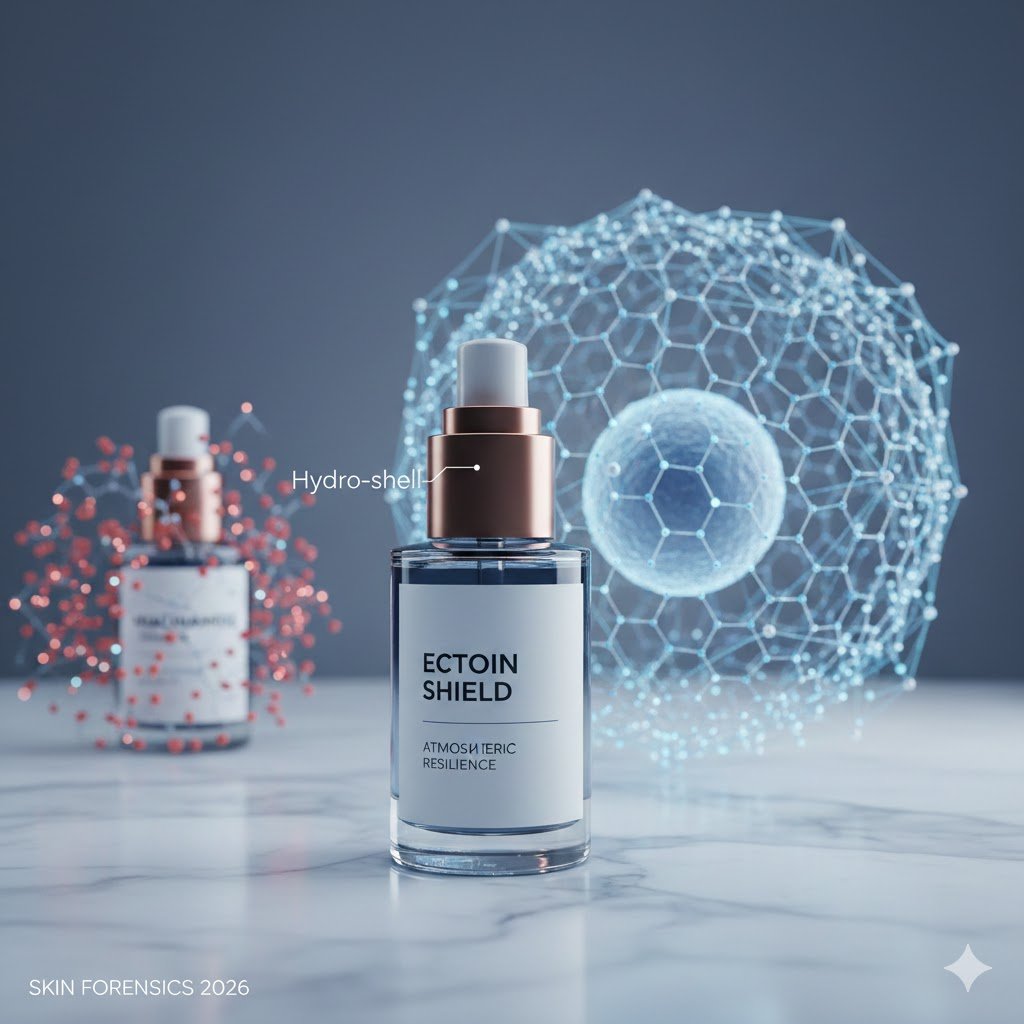
For the most resilient skin-state possible, pair your Slushy with an Ectoin-based serum. In my Ectoin vs. Niacinamide Forensic, I explain how Ectoin creates a “Hydro-shell” to protect your surface proteins. When you use Ectoin to guard the outside and Glycerol-Glucoside to power the inside, you aren’t just moisturizing—you are building a 2026-grade biological fortress.
Forensic FAQ: Solving the Hydration Puzzle
1. My face still feels tight after using oil; is Glycerol-Glucoside the missing link?
Exactly. Oils are “passive”—they trap what’s already there. If your internal water gates (Aquaporins) are rusted shut, the oil is just sealing in dryness. Glycerol-Glucoside reopens those gates so your skin can finally drink from the inside.
2. Can I use a ‘Slushy’ gel if I have oily or acne-prone skin?
Yes, and it’s actually preferred. Unlike face oils, which can be comedogenic or “sticky,” these gels are weightless. They provide deep hydration without the heavy esters that often trigger congestion or “slugging-induced” breakouts.
3. How long until I see “The Snap” (biological plumping)?
While you’ll feel the cooling relief instantly, the biological “reboot” of Aquaporin proteins typically takes 3 to 7 days of consistent use. By day 10, the skin should feel bounce-back resilient even without a fresh application.
4. Is it safe to layer this with high-strength Retinoids?
It’s more than safe—it’s a strategic defense. Retinoids often cause “stiffness” by disrupting the barrier. Applying your Slushy gel first creates a reservoir of hydration that helps the skin tolerate Vitamin A much more gracefully.
5. Does this replace my moisturizer entirely?
In humid or urban 2026 climates, yes. If you are in an
About The Author