It is difficult to pinpoint a molecule that has gone through as much rigorous scrutiny as Nicotinamide in the landscape of modern topical vitamins. According to research that has been done on Niacinamide benefits, the data consistently demonstrate how versatile it is as a precursor to NAD(P)H, which is essential for the generation of cellular energy and its repair. There has been a significant gap between clinical evidence and commercial marketing-specifically when it comes to the percentage of active ingredient used in daily serums that is based on clinical evidence.
While the consumer market in North America and Europe has pushed for formulations that are 10%, 15%, and even 20% stronger, the foundational research on the skin barrier often tells a different story. In order to understand what these concentrations actually do to the dermis, one must look at the skin’s biochemical saturation point in order to understand how they work.
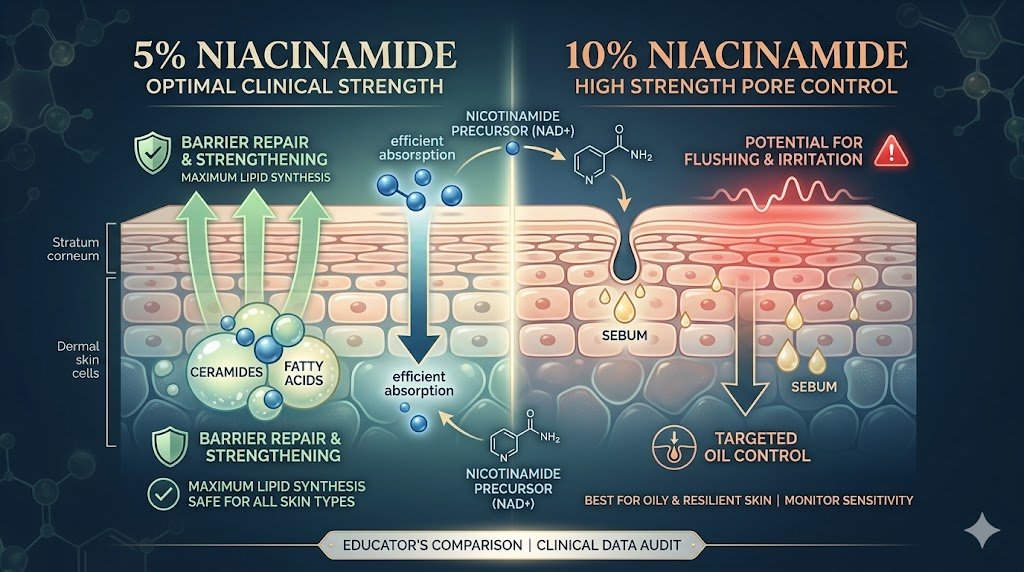
The 5% Concentration: The Clinical Gold Standard
In recent studies, it has been found that much of the peer-reviewed research that established Niacinamide’s core benefits used concentrations between 2% and 5% in order to establish the benefits of Niacinamide. It has been proven that at these levels, a significant improvement can be seen in the “barrier function” of the skin.” However, higher concentrations, such as 10%, may offer additional benefits, including enhanced anti-inflammatory effects and improved reduction of hyperpigmentation. Despite these potential advantages, it’s also important to consider that higher doses can sometimes lead to skin irritation or sensitivity, especially for those with sensitive skin types. Therefore, it’s essential to balance efficacy with tolerance when choosing a concentration suitable for individual needs.
Ceramide Synthesis and Lipid Barrier Support
According to some studies, a 5% concentration is the “sweet spot” for stimulating ceramides, the glue that keeps the skin cells together and plays a critical role in skin regeneration. According to research, the skin has an increased level of free fatty acids and cholesterol when it is treated with this specific percentage. It would appear, thus, for a researcher auditing the facts provided above, that this would suggest that the skin would be better able to retain moisture and protect itself against environmental stressors than it would have been otherwise. This enhanced moisture retention and barrier protection can help reduce dryness, flakiness, and sensitivity caused by external factors like pollution or UV exposure. Consequently, a 5% concentration may be particularly beneficial for individuals with compromised skin barriers or those seeking long-term skin health improvements.
Pigmentation and Cytokine Regulation
There is evidence that Niacinamide may be beneficial in the treatment of hyperpigmentation, and clinical studies suggest that 5% of Niacinamide is sufficient to prevent the transfer of melanosomes from melanocytes to keratinocytes. The Niacinamide 5% reacts as a regulator of the skin, unlike acids that contain high levels of strength that can peel the skin. There are many expert reviews in the UK and the US which mention this percentage as the minimum amount which is needed to reduce the appearance of “blotchiness” over a period of 12 weeks in the majority of cases. This is because Niacinamide at 5% concentration effectively regulates skin processes by inhibiting the transfer of pigment-containing melanosomes to surrounding skin cells, reducing visible discoloration. Unlike stronger acids that can cause peeling or irritation, it works as a gentle regulator, making it suitable for long-term use. Expert reviews in the UK and US support this claim, noting its ability to improve “blotchiness” over 12 weeks, particularly for those with sensitive or compromised skin barriers. This mechanism highlights its role in addressing hyperpigmentation without aggressive exfoliation, offering a balanced approach to skin health improvement.
10% Concentration: High Strength vs. High Irritation
It is believed that the movement toward 10% Niacinamide was mainly caused by the “Percentage Wars” that have taken place in Tier-1 skin care markets. There are some specific scenarios where research suggests that higher concentrations may play a role, but even then, there are tradeoffs involved – and higher concentrations may not always be better.The “Percentage Wars” refer to a marketing trend where brands compete to offer higher concentrations of active ingredients, suggesting they are more effective. However, this can mislead consumers into thinking higher percentages always yield better results, when in reality, higher concentrations may increase the risk of irritation or diminish the ingredient’s stability and efficacy. For niacinamide, research shows that concentrations above 5% can sometimes cause irritation without significantly improving outcomes, which is why 10% became a compromise between perceived strength and practical usability.
Sebum Control in Acne-Prone Research
If you are interested in the “Oil Control” benefits of Niacinamide, some research has shown that 10% formulations may have an aggressive effect on the sebaceous glands more so than 5% formulations. There have been studies that suggest that this concentration may contribute to a reduction in sebum excretion in people with severe oily types of skin. It is also at this point that “Niacinamide flushing” becomes a reported occurrence, and it is also a very important point to understand.This flushing effect, characterized by redness or warmth, occurs as the skin adjusts to the higher concentration. While it is generally temporary and harmless, it can be uncomfortable for some users. Therefore, individuals with sensitive skin might benefit from starting with lower concentrations to minimize irritation while still reaping the oil-control benefits of niacinamide.The 10% concentration was chosen as a compromise because higher concentrations, while more effective at reducing sebum production in oily skin, can cause discomfort like flushing. This side effect, though temporary, may deter users with sensitive skin. Lower concentrations, such as 5%, are gentler and less likely to cause irritation but may not provide as strong an oil-control effect. Therefore, 10% balances the need for efficacy in managing sebum without being overly harsh for most users, making it a practical choice for formulating products targeted at acne-prone or oily skin types.
The saturation fact
A certain amount of vitamin B3 can only be utilized by the skin at a given time, due to its biochemical properties. A serum that contains 10% of the active ingredient is likely to leave an excess molecule on the surface, which can lead to irritation. There are times when users in cold climates, such as Canada and the UK, may experience localized redness or something called “micro-irritation” which, in turn, can damage the barrier that is supposed to be protected by the molecule.This suggests that users in such climates might benefit from lower concentrations or alternate formulations to minimize irritation while still reaping the benefits of vitamin B3. Adjusting usage frequency or pairing it with barrier-supporting ingredients can help mitigate these effects and maintain skin health in harsher environmental conditions.Users in cold climates should consider lower concentrations or formulations that support the skin barrier to avoid irritation while still benefiting from vitamin B3.For example, using a 5% niacinamide serum instead of 10% can reduce the risk of irritation while still providing hydration and barrier support, as studies suggest concentrations above the skin’s absorption threshold may not increase efficacy but can heighten sensitivity.
When we examine the literature, we see that most foundational studies on skin brightening and barrier repair were performed at 5%. While 10% is popular, it is important to remember that doubling the concentration does not double the results; instead, it often increases the risk of sensory irritation in sensitive populations.” — Clinical Research Note (Reference Archive)
For a global audience auditing their routine, the choice between 5% and 10% should be based on the “Dermal Goal.”
Benefit Category
5% Clinical Observation
10% Research Observation
Barrier Repair
Optimal. Studies suggest maximum ceramide boost.
Potential for irritation in dry climates.
Pore Appearance
Significant improvement in texture.
Faster sebum reduction in oily skin.
Fine Lines
Documented reduction over 12 weeks.
No significant advantage over 5% in studies.
Skin Sensitivity
Safe for most, including Rosacea-prone.
May cause temporary flushing or redness.
Why Niacinamide Won’t Absorb at High Percentages
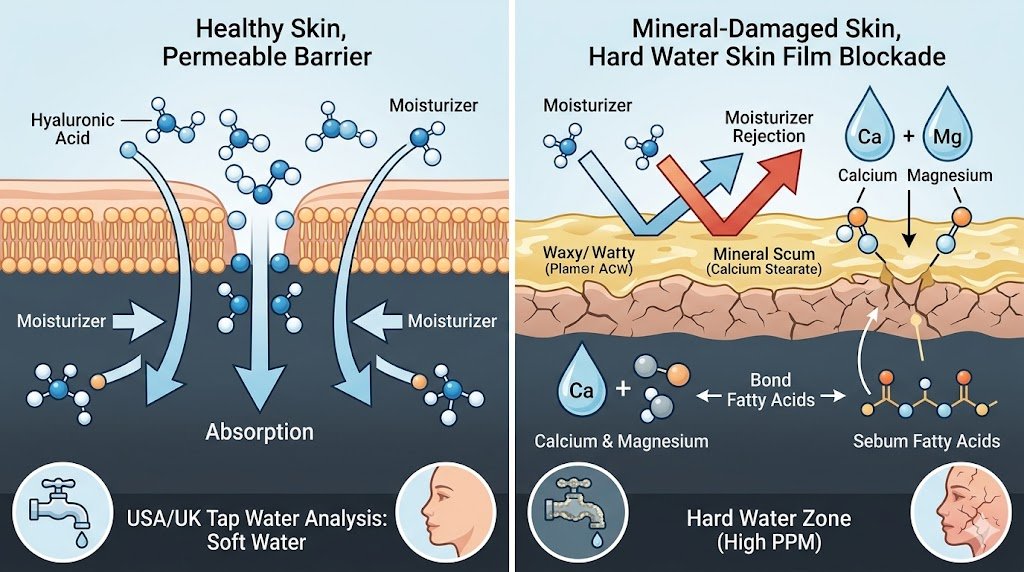
It is similar to our audit on Hard Water Skin Film that the efficacy of Niacinamide is dependent on the overall health of the skin. There will be some difficulties in penetrating waxy calcium salts on the skin if a user has a heavy mineral buildup on their skin, even a 10% Niacinamide serum. According to research, Niacinamide’s benefits cannot be realized until the ‘Skin Scum’ layer is addressed first, otherwise, the molecule will simply crystallize on the surface, potentially causing “pilling” of the skin.To address this, users should focus on exfoliating and cleansing routines to remove mineral buildup before applying niacinamide. Incorporating gentle exfoliants or pH-balancing cleansers can help improve absorption. Additionally, moisturizers with humectants like glycerin can enhance niacinamide’s effectiveness by maintaining hydration and supporting the skin’s natural barrier function.To fully benefit from niacinamide, it is essential to prepare the skin by removing mineral buildup through exfoliation and cleansing, as this ensures proper absorption and prevents surface crystallization or “pilling.”
Internal Research Audit Link
You should first understand the underlying cellular signaling and cellular function of Niacinamide if you are currently researching Niacinamide benefits in order to fix a “broken” skin barrier. In our previous forensic audit, The PDRN Experiment: Analyzing Salmon DNA Signaling, we investigated how polynucleotides could signal the skin to repair itself at a deeper level than traditional vitamins can reach. Those molecules provide the “blueprints” for the barrier while Vitamin B3 provides the “bricks” for the barrier.
Conclusion: Navigating the 5% vs. 10% Research Data
The question is, which one should you choose?
There are studies that show that starting at 5% is a good place to start for almost anyone. The product gives you the barrier strengthening and brightening results that you want in a safe way.
In the majority of cases, a 10% serum is not necessary for skin types other than those with extremely stubborn oily skin and those who have already had their skin “vetted” with lower concentrations.
Always remember: Skincare is not a race to the highest percentage. It’s about finding the dose your skin can actually use.Skincare is about tailoring the concentration to your skin’s needs, prioritizing safety and effectiveness over simply using higher percentages unnecessarily.
Atul Kumar is a skincare enthusiast and independent researcher passionate about helping readers understand the science behind everyday beauty products. With a focus on ingredient research, Atul writes evidence-based guides and reviews to help people make informed choices for healthier, glowing skin. He combines practical tips with scientific insights, making complex skincare concepts easy to understand for everyone.
Atul Kumar is a skincare enthusiast and independent researcher passionate about helping readers understand the science behind everyday beauty products. With a focus on ingredient research, Atul writes evidence-based guides and reviews to help people make informed choices for healthier, glowing skin. He combines practical tips with scientific insights, making complex skincare concepts easy to understand for everyone.